A Wobbling Ceiling Fan Turned Into a Full Teardown (And a Broken Bed)
A simple ceiling fan balance job turned into a full disassembly, a loose motor mount, and an unplanned bed repair. Here's how a five-minute fix became an all-day project.
Equipment You May Need
Worth the fix?
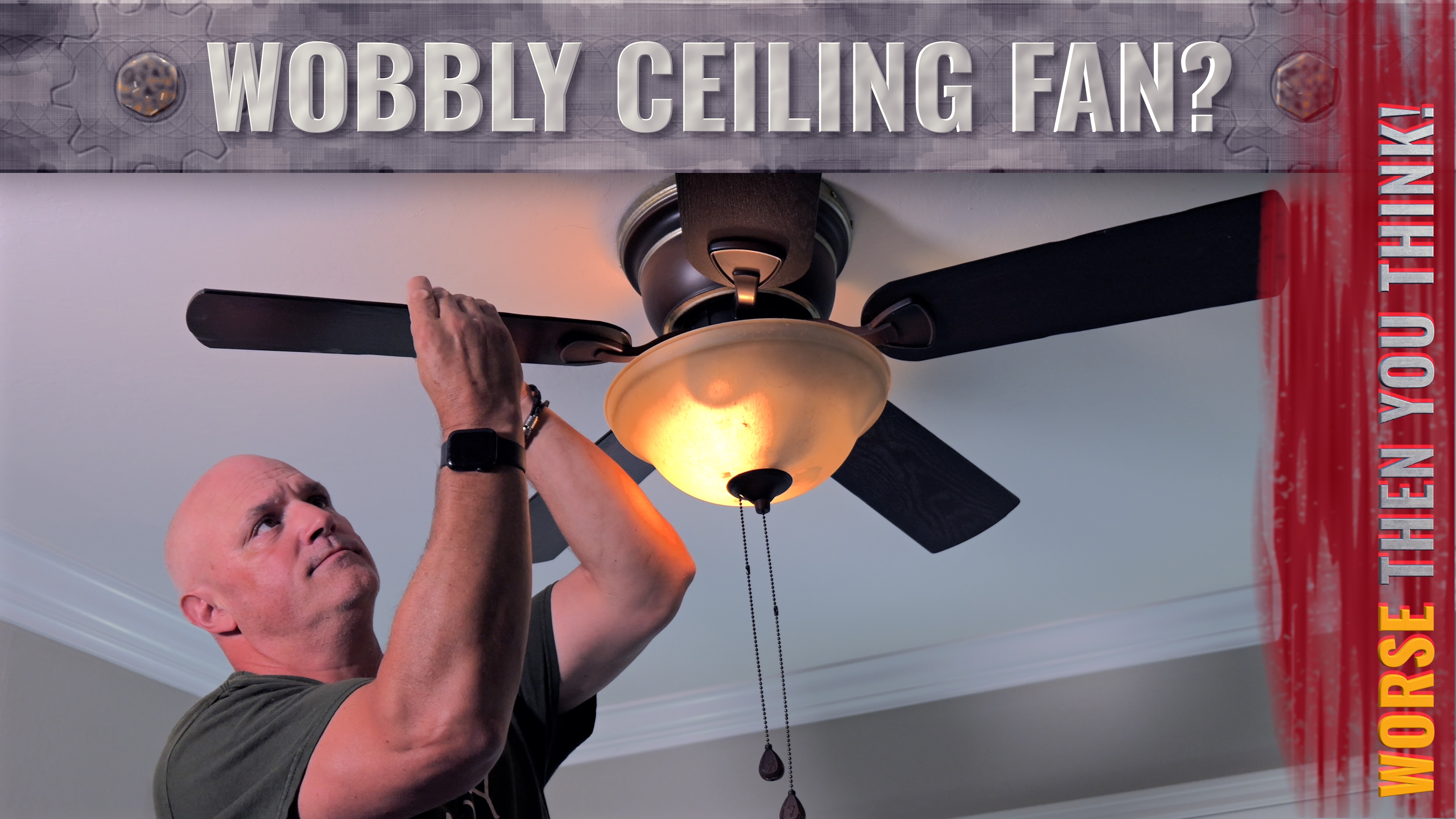
What starts as a balancing kit fix can turn into a full teardown — budget more than a few minutes if the wobble doesn't quit.
The Fix
Fixing things yourself can be rewarding, and it can save real money — but it can also go sideways fast, and a wrong turn can end up costing more than just calling a professional. This is one of those jobs. It started as a five-minute fan-balancing fix and ended up as a full teardown of the fan, the motor mount, and, somehow, the bed frame underneath it.
The Wobble That Wouldn't Quit
We have a downstairs bedroom we mostly use for storage and as a hideout for the dog. One day the light in there caught my eye — dim and orange, barely brighter than a candle. Simple enough, I figured: swap the bulbs. But when I turned on the fan to get a better look, it wobbled so hard it looked ready to fly off its mount.
That's normally not a big deal. A wobbling fan usually just needs balancing: clip a small weight onto a blade, run the fan, and repeat with a different blade until it smooths out. I've installed and balanced plenty of fans over the years, so I figured this would make for a quick, easy video. That confidence didn't last — I balanced every blade and the fan kept shaking just as badly as before. Since balancing wasn't fixing it, something structural had to be wrong, and the only way to find out was to take the whole thing apart.
Tearing Into the Fan
Taking things apart to see what's actually wrong is one of my favorite parts of a repair, so I wasn't complaining — just a little nervous, since my wife was filming the whole thing and I had no idea what we'd find.
I started by unclipping the pull chains for the lights and fan speed, then removing the glass bowl covering the bulbs. Only one of the two bulbs had been working, and it turned out the other had actually cracked inside the bowl — almost certainly from the fan running while it was violently out of balance. The lower switch housing came off next: three screws and a wiring harness that unclipped easily.
The fan blades took a bit more figuring out. The main housing had a small notch cut into it to fit a screwdriver through, so I rotated the fan until each blade's mounting screw lined up with the notch and backed them out one at a time. With the blades off, the outer housing cover came free (two screws removed, two more loosened), which finally exposed the motor body and its mounting bracket.
The Motor Mount That Wouldn't Budge
This is where things stalled. The motor body was held in the housing by four screws and two lips that were supposed to seat into notches on the bracket. Loosening the screws pushed their heads up into the bracket and shoved the whole assembly up into the ceiling drywall. Tightening them did the opposite — pushed the bracket down so the lips dropped into their notches, but also jammed everything against the drywall. Loosen it or tighten it, I was stuck either way.
An Unplanned Bed Repair
My wife, Vung, climbed up to help. The room isn't big enough to move the bed out from under the fan, so the bed became our ladder. While we were both up there working the motor body, we heard a loud snap and felt the bed shift. We looked at each other and realized we'd probably just broken it — which is exactly the moment you start second-guessing the whole DIY plan.
With our ladder gone, we pulled the mattress and box spring off to see what happened, and found the real problem: the bed's cross support beams had never been installed. The movers who reassembled our furniture during our move had only put in the main support rail and skipped the lateral braces entirely. What looked like a disaster turned out to be a lucky catch — that bed was going to fail eventually, and better now than with guests in the room.
The fix was straightforward once we saw it. The main support beam has a lip that seats into a slot on the headboard and footboard, and that lip had bent backward under the load. A pair of channel-lock pliers bent it back into place. The cross beams' screws didn't seat properly, so a quick hardware store run got us the right nuts, bolts, and washers to secure them. With the main beam back in its slot and every lateral brace screwed down tight, the bed was finally — for the first time since we moved in — properly assembled. We left the mattress off and switched to a step stool to finish the fan.
Finding the Real Problem
Eventually the motor body worked loose and slid out with a bang. It was immediately obvious why it had been loose: sitting the way it was in the bracket, it never could have been tightened down properly. Whether that was a bad install years ago or the screw heads had simply worked their way through the mounting holes over time, I can't say for sure — my money's on the screw holes wearing through. Either way, the loose motor bracket was the actual source of the wobble, not the fan blades.
Putting It Back Together
Step one was tightening the motor body to the bracket properly — which meant a trip to the hardware store to find a washer wide enough to fit over the mounting screws and span the worn holes.
Step two was securing the motor body to the bracket with the original four screws and the new washers, giving the screw heads a much wider bearing surface so they couldn't pull through again. Once tightened down, the whole unit was rock solid — clearly the fix the fan actually needed.
Step three was reassembly. Getting the housing and blades back on was mostly a reverse of teardown, though lining up each blade's screw with the motor body's notch was its own small battle — holding a blade overhead, keeping the screwdriver aligned, and stopping the blade from swinging away from the notch all at once.
With the blades back on, I reconnected the wiring and switch housing and installed new bulbs — which, of course, used a smaller, non-standard thread, so our first set didn't fit and we made another trip for the right size. After that: bowl back on, pull chains reattached, power back on. The light was bright and even, and the fan spun with barely a wobble left.
The Final Balance
Step four was rebalancing the blades. The very first blade I tried a weight on killed almost all of the remaining wobble — peel the adhesive backing, stick the weight to the blade, and the fan finally ran smooth.
What Started Small Didn't Stay Small
A job that should have taken a few minutes turned into several hours — a torn-down fan, a rebuilt motor mount, and a bed frame that got properly assembled for the first time. That's how DIY goes sometimes: you start out trying to do something nice for your wife and end up several projects deep. It's still worth it. We saved a few hundred dollars over buying a new fan, and now we know exactly what was wrong and how to fix it if it ever comes up again.
And of course, the only other ceiling fan in the house — in our daughter's room — isn't working either. The DIY dad's job is never done. That one's up next.